
Wednesday, November 28, 2012

Wednesday, November 21, 2012

Wednesday, November 14, 2012
Internship - Day 13.0
Quality Control
The task today was to begin executing on my quality control (QC) recommendations for unfinished collections started by student assistants. The student assistants are not expected to have a foundation of archival theory or experience. Mostly, they are instructed on how to perform repetitive tasks such as refoldering, labeling, and rehousing materials. So that's where I pick up on the first two of five such collections.
I'm pleased to find mostly tidy and neatly labeled materials, although I'm not sure if the students were instructed to maintain original order or how they made their refoldering choices. I'm guessing they maintained original order -- if only by default.
The first thing I did was compare the folders and their labels with what was input into Archivists' Toolkit (AT). Right off the bat I found the collection number was missing from all of the folder labels. Also, there was a date range mismatch between what was on the folder labels and what was input into AT. Some materials genres were misidentified, such as calling a pamphlet or report a booklet. There were no names or subjects selected for the collection nor were there any notes other than a Content and Scope note, and that probably migrated from the accession record. In one case, a too-large sized box was used for a thin stack of folders.
This all may sound a bit nit-picky, but the procedures and expectations for the quality of arrangement and description at UCI Special Collections and Archives is high. And the things I'm catching and fixing are really the realm of an archivist. It was heads down, intensive work, but this exercise was good practice and reinforcement for me.
The task today was to begin executing on my quality control (QC) recommendations for unfinished collections started by student assistants. The student assistants are not expected to have a foundation of archival theory or experience. Mostly, they are instructed on how to perform repetitive tasks such as refoldering, labeling, and rehousing materials. So that's where I pick up on the first two of five such collections.
I'm pleased to find mostly tidy and neatly labeled materials, although I'm not sure if the students were instructed to maintain original order or how they made their refoldering choices. I'm guessing they maintained original order -- if only by default.
The first thing I did was compare the folders and their labels with what was input into Archivists' Toolkit (AT). Right off the bat I found the collection number was missing from all of the folder labels. Also, there was a date range mismatch between what was on the folder labels and what was input into AT. Some materials genres were misidentified, such as calling a pamphlet or report a booklet. There were no names or subjects selected for the collection nor were there any notes other than a Content and Scope note, and that probably migrated from the accession record. In one case, a too-large sized box was used for a thin stack of folders.
This all may sound a bit nit-picky, but the procedures and expectations for the quality of arrangement and description at UCI Special Collections and Archives is high. And the things I'm catching and fixing are really the realm of an archivist. It was heads down, intensive work, but this exercise was good practice and reinforcement for me.
Wednesday, November 7, 2012
Internship - Day 12.0
Refinement
Much of today was spent heads down reviewing my first collections and applying corrections. The exercise of upgrading the processing level on the ECOC and FHCOC collections from minimal to moderate involved the application of new work by student assistants and by an intern (me). This of course had the effect of introducing new errors in the form of typos and unmet requirements.
As I compared physical file folder labels with the data input into Archivists' Toolkit, I found discrepancies that needed to be fixed between the two. Through a combination of the backspace, an eraser, and a pencil I brought the two sides back in alignment. As usual, my supervisor had some great feedback that only improved the quality of the finding aids for these two collections.
New Challenge
The rest of my day was spent working on a new challenge presented to me by my supervisor . Special Collections has a backlog of five collections previously processed by student assistants. They needed to have some quality control (QC) applied before they could be considered complete. My supervisor explained that as a future archivist who will be supervising non-archivists, I could benefit from checking the work of our student assistants. This will give me a chance to apply the learning I've gained over the previous three months.
The collection I picked to QC first was MS-R160 - Committee of 4000 records, a group of Irvine area homeowners who lived on land leased to them by the Irvine Ranch/Company and argued that their original lease terms were unrealistic in the 1970s climate of soaring Orange County real estate prices. By the end of the day I delivered my QC recommendations to my supervisor for review. Next week I'll tackle the other four collections.
Much of today was spent heads down reviewing my first collections and applying corrections. The exercise of upgrading the processing level on the ECOC and FHCOC collections from minimal to moderate involved the application of new work by student assistants and by an intern (me). This of course had the effect of introducing new errors in the form of typos and unmet requirements.
As I compared physical file folder labels with the data input into Archivists' Toolkit, I found discrepancies that needed to be fixed between the two. Through a combination of the backspace, an eraser, and a pencil I brought the two sides back in alignment. As usual, my supervisor had some great feedback that only improved the quality of the finding aids for these two collections.
New Challenge
The rest of my day was spent working on a new challenge presented to me by my supervisor . Special Collections has a backlog of five collections previously processed by student assistants. They needed to have some quality control (QC) applied before they could be considered complete. My supervisor explained that as a future archivist who will be supervising non-archivists, I could benefit from checking the work of our student assistants. This will give me a chance to apply the learning I've gained over the previous three months.
We agreed that I would pick one of the five student-processed collections and develop a list of recommendations for improvement. My supervisor would then QC my QC, provide feedback, and then have me apply the agreed upon changes.
 |
| Old days on the Irvine Ranch. |
Wednesday, October 31, 2012
Internship - Day 11.0
AT and MP
Today was a repeat of last week with regards to processing. As was done for the Environmental Coalition of Orange County (ECOC) collection, I made another pass on the Fair Housing Council of Orange County (FHCOC) records to bring them up to a moderate level of processing. Good reinforcement of technique, but nothing new to report to you, my dear readers.
Instead, I'd like to take the opportunity today to sing the praises of Archivists' Toolkit (AT) and how it supports the efficient character of Minimal Processing (MP). Perhaps you'll consider these observations a bit mundane, but while processing the FHCOC collection I was struck by how seamlessly original order is maintained, even as the archivist intellectually creates order from chaos. Let me explain:

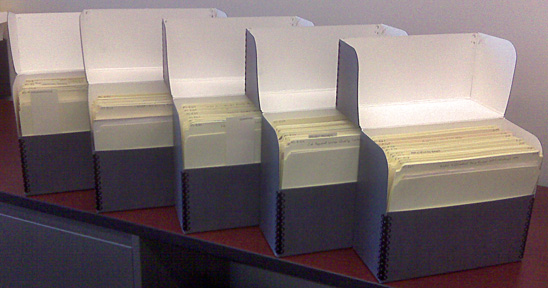
Here are boxes 2 through 4 (right to left) of the processed FHCOC collection. The contents are filed in approximately the same jumbled order in which I found them in the original bankers box when they arrived in Special Collections and Archives -- their original order. For the most part, there was little in the way of organization, except there was a thin set of about four folders which had been previously processed by a prior caretaker. This gave me pause and I had to consider that there was some method to the madness confronting me. I decided to keep everything in the box in the sequence in which it came to maintain its original order. If there was an order, it was well hidden, but perhaps it would reveal itself after working with it a bit.
In retrospect, there wasn't any order, or value to maintaining the physical order of the contents, other than to save me the step of reordering similar papers together. Being somewhat obsessive, I had to resist more than once the temptation to reorder the papers. After refoldering the documents and labeling the folders it became more difficult to justify the rework of putting the papers into an artificial order. So the urge diminished.
The aspect that did reveal itself, though, was that after inputting the series, subseries, and folder labels into AT, the reordering I had resisted doing physically could be accomplished electronically. By dragging the entries into a semblance of order my want for physical reordering was satisfied -- and while maintaining the physical original order of the papers.
Here's the finished AT Resource view of the entire collection:

Note the highlighted filing unit for the year 1975 under the series/subseries Legal documents | Court documents (click on the image to enlarge). This is not one folder of court documents from 1975, but one entry that represents three folders. Check out the Instances on the right side of the frame. You can see there are three instances (folders) of 1975 court document spread across three boxes. The locations of the three folders is indicated by the salmon-colored flags in the first image above. So even though the three folders are physically split up, they have been brought together intellectually in AT under one child entry.
The beauty of this is that the archivist is freed from having to physically reorder the contents of collections, even when the material may cry out for artificial organization. The sorting, ordering and consolidating of like documents can be done electronically as a final step after inputting each of the folder labels into AT. Minimal processing is supported because any temptation to reshuffle papers into order is unnecessary, unjustified, and thus eliminated. Original order is maintained as a matter of course (even if it has no obvious value) while simultaneously saving the archival processor time, effort, and work space that physical reordering of documents would require. This is a beautiful thing.
Today was a repeat of last week with regards to processing. As was done for the Environmental Coalition of Orange County (ECOC) collection, I made another pass on the Fair Housing Council of Orange County (FHCOC) records to bring them up to a moderate level of processing. Good reinforcement of technique, but nothing new to report to you, my dear readers.
Instead, I'd like to take the opportunity today to sing the praises of Archivists' Toolkit (AT) and how it supports the efficient character of Minimal Processing (MP). Perhaps you'll consider these observations a bit mundane, but while processing the FHCOC collection I was struck by how seamlessly original order is maintained, even as the archivist intellectually creates order from chaos. Let me explain:

Here are boxes 2 through 4 (right to left) of the processed FHCOC collection. The contents are filed in approximately the same jumbled order in which I found them in the original bankers box when they arrived in Special Collections and Archives -- their original order. For the most part, there was little in the way of organization, except there was a thin set of about four folders which had been previously processed by a prior caretaker. This gave me pause and I had to consider that there was some method to the madness confronting me. I decided to keep everything in the box in the sequence in which it came to maintain its original order. If there was an order, it was well hidden, but perhaps it would reveal itself after working with it a bit.
In retrospect, there wasn't any order, or value to maintaining the physical order of the contents, other than to save me the step of reordering similar papers together. Being somewhat obsessive, I had to resist more than once the temptation to reorder the papers. After refoldering the documents and labeling the folders it became more difficult to justify the rework of putting the papers into an artificial order. So the urge diminished.
The aspect that did reveal itself, though, was that after inputting the series, subseries, and folder labels into AT, the reordering I had resisted doing physically could be accomplished electronically. By dragging the entries into a semblance of order my want for physical reordering was satisfied -- and while maintaining the physical original order of the papers.
Here's the finished AT Resource view of the entire collection:

Note the highlighted filing unit for the year 1975 under the series/subseries Legal documents | Court documents (click on the image to enlarge). This is not one folder of court documents from 1975, but one entry that represents three folders. Check out the Instances on the right side of the frame. You can see there are three instances (folders) of 1975 court document spread across three boxes. The locations of the three folders is indicated by the salmon-colored flags in the first image above. So even though the three folders are physically split up, they have been brought together intellectually in AT under one child entry.
The beauty of this is that the archivist is freed from having to physically reorder the contents of collections, even when the material may cry out for artificial organization. The sorting, ordering and consolidating of like documents can be done electronically as a final step after inputting each of the folder labels into AT. Minimal processing is supported because any temptation to reshuffle papers into order is unnecessary, unjustified, and thus eliminated. Original order is maintained as a matter of course (even if it has no obvious value) while simultaneously saving the archival processor time, effort, and work space that physical reordering of documents would require. This is a beautiful thing.
Wednesday, October 24, 2012
Internship - Day 10.0
Minimal to Moderate Level Processing
Always keeping me on my toes, my mentor my supervisor presented me with a new challenge; try my hand at processing a collection at the moderate-intensive level. She suggested that, given I have organized the first collection of materials (ECOC MS-R164) at the folder level it would be appropriate to describe them (even if briefly) in the finding aid. My supervisor directed my attention to the sections of the processing manuals that instruct on the requirements for Moderate levels of control.
So I paged the boxes from the stacks in the basement cage and did a deeper dive into the ECOC materials. Whereas I had previously had only described the scope and contents of the records at the collection level, I now developed Scope and Content notes for the series and subseries levels, and Arrangement notes at the series level. I'll also make use of the student staff to add the existing folder listings into AT under the corresponding series and subseries.
It took me all day to process at the moderate level, but in the end these additional efforts will have the effect of increasing the richness of the finding aid providing more detailed and varied keywords a researcher can analyze in their search results. And your humble Archivist Apprentice will have added another brick in the foundation of his experience.
Always keeping me on my toes, my mentor my supervisor presented me with a new challenge; try my hand at processing a collection at the moderate-intensive level. She suggested that, given I have organized the first collection of materials (ECOC MS-R164) at the folder level it would be appropriate to describe them (even if briefly) in the finding aid. My supervisor directed my attention to the sections of the processing manuals that instruct on the requirements for Moderate levels of control.
 |
| ECOC boxes retrieved for moderate level processing. |
It took me all day to process at the moderate level, but in the end these additional efforts will have the effect of increasing the richness of the finding aid providing more detailed and varied keywords a researcher can analyze in their search results. And your humble Archivist Apprentice will have added another brick in the foundation of his experience.
Wednesday, October 17, 2012
Internship - Day 9.0
FHCOC Reconsidered
At the end of the day last week, I asked my supervisor to review my AT resource record for the Fair Housing Council of Orange County (FHCOC) collection. As mentioned earlier, the collection does not have much variety in types of documents it contains, but is challenging in that the original order resembled the aftermath of 52-card pickup. But not to worry, the beauty of electronic finding aids is that original order can be maintained, yet the materials can be arranged intellectually for easy reference and easy retrieval.
First thing this morning, my supervisor shared her thoughts on the next steps for the FHCOC records. She made some excellent suggestions. This is the exact situation that makes an internship so valuable. I made my best effort at applying the archival theory I've learned from coursework and professional publications and then get to have it reviewed by an experienced archivist who gently makes excellent suggestions for improving the usefulness of the finding aid for research. Based on our discussion, I modified my series arrangement from:
...to the following series and subseries...
I concluded the day's tasks by labeling the document boxes, shelving them, updating the Stacks Locator, and updating the Accessioning Checklist and Processing Work Plan.
 |
| FHCOC in the stacks. |
First thing this morning, my supervisor shared her thoughts on the next steps for the FHCOC records. She made some excellent suggestions. This is the exact situation that makes an internship so valuable. I made my best effort at applying the archival theory I've learned from coursework and professional publications and then get to have it reviewed by an experienced archivist who gently makes excellent suggestions for improving the usefulness of the finding aid for research. Based on our discussion, I modified my series arrangement from:
- Court documents
- Regulatory documents
- Planning documents
- Newsletters
...to the following series and subseries...
- Legal documents
- Court documents
- Settlements
- Publications
- Regulatory documents
- Planning documents
- Newsletters
I concluded the day's tasks by labeling the document boxes, shelving them, updating the Stacks Locator, and updating the Accessioning Checklist and Processing Work Plan.
Subscribe to:
Posts (Atom)