Meet the Intern
During the fall of 2012 I had the pleasure and privilege of working as an archival intern at UC Irvine Libraries Special Collections and Archives (SC&A). For a graduate MLIS student interested in being exposed to archival best practices in a professionally run environment, UCI's SC&A easily fits the bill.
I am an Information Technology professional by trade and I volunteer for a California desert historical society in my free time. After thirty years of making a living in business information around Orange County, I decided to pursue a second career in history information -- an occupation otherwise known as archivist.
Archivists preserve and make accessible the documentary evidence of our American heritage. It is a somewhat obscure profession (there are only 6,000 practicing, and 1,100 certified archivists in the U.S.), yet it is the only one dedicated to maintaining the existence of our historical record. Archival practice is rooted in librarianship and students are typically educated through a master's program in library and information science (MLIS) or history.
As part of the MLIS educational experience students are encouraged to obtain practical experience by means of internship programs in working archives. I work and live in south Orange County in southern California. The UCI campus has been a recurring theme in my life although my higher education has been obtained primarily from Cal State institutions. Through my coursework I was familiar with Michelle Light’s
publications and learned she was the Head of Special Collections, Archives, and Digital Scholarship at UCI. From her presentation at the 2011 Society of American Archivists conference I learned that the department she managed was at the forefront of archival practice. I introduced myself and she encouraged me to apply for an internship at SC&A.
The learning outcomes I intended to satisfy through my internship revolved around the gaps in my practical knowledge of how to process archival collections. My MLIS coursework and supplemental reading of archival science literature have
provided me with the principles and knowledge required, but the practical
skills that come from hands on processing were missing. Life experiences have taught me that there is no substitute for understanding the particulars of a process other than to roll up one’s sleeves and personally perform the work. UCI SC&A offered me the opportunity to test theories and to practice skills by engaging in a field-based learning experience. Secondary considerations that contributed to my site choice were the desire to be guided by professional archivists, work in an environment utilizing best practices and technology-based solutions, and to process regional (Orange County) collections.
The Internship Site
The UCI Libraries, Special Collections and Archives houses the UC Irvine Libraries' collections of rare books, manuscripts, archives, photographs, and other rare and special materials. The department is home to the scholarly archives of some of the campus's most noteworthy present and former faculty members, including philosopher Jacques Derrida, Nobel Prize-winning scientists F. Sherwood Rowland and Frederick Reines, and choreographers Eugene Loring and Donald McKayle. Students, researchers, and community members are encouraged to visit and use the collections and services available within the department’s reading room.
The Special Collections and Archives department, stacks, and reading room are situated on the top floor of the main or Langson library. The reading room is a large, neat and pleasant environment of large tables with large windows overlooking the campus. The reading room also shares space with a limited number of stacks and map files.
Staff offices, cubicles, student assistant work areas, and additional stacks are located off the reading room. Additionally, there is separate secure space on the fifth floor with work and storage space and where bulk archival supplies are kept. In the basement of the Langson, SC&A has several compact stacks behind two locked cages within the academic library space. Lastly, there is a work area in the newer Ayala Science Library where a project archivist is stationed processing regional collections.
Outreach activities conducted by SC&A include both traditional exhibits and use of social media. During the fall Special Collections displayed “LGBT Communities in Orange County: Highlights from the Archival Collections” in the Special Collections and Archives lobby exhibit cases. Publicity for SC&A public programs is disseminated through its New & Noteworthy Collections blog and the UC Irvine SC&A Twitter feed. There are efforts currently underway to digitize early University materials for presentation in a web-based content management system. This is being done in anticipation of UCI's 50th anniversary in 2015.
Back in the staff area of the Langson, one of two cubicle spaces is set aside for sharing by transient resources such as interns. It’s a nice space with a networked computer, a decent amount of flat work area, and a window view of the San Gabriel Mountains. Archivists’ Toolkit is the archival data management technology used along with a home-grown Stacks Locator for logging the locations of shelved collections. Other utilities such as JEdit and NetDrive used to upload EAD to OAC are covered in my Day 8.0 blog post.
In addition to putting in a full day of interning once per week at UCI Special Collections and Archives, I maintained a weekly blog called Archivist Apprentice. To generate additional interest in the blog postings, a companion Archivist Apprentice Twitter account was used to tweet the presence of new postings to followers.
Internship Reflections
Overall, my internship at the UCI SC&A was a personal success because I was able to accomplish the goals I set out for myself. Most of my MLIS coursework has revolved around archival theory. This internship was my opportunity to apply that theory in a practical setting in highly organized archives under professional guidance. At its core, my plan was to process manuscript collections from “soup to nuts,” and the wonderful archivists at UCI helped me do just that over the course of 138 hours of hands-on work on seven collections comprising 7.6 linear feet of processed material.
To make the best use of my short time “on station” at my internship, I would spend the first half hour or so of my day determining what I needed to do to complete a module of work before I went home. I did not want to leave in the middle of any one task and lose my train of thought before I came back a week later. This required me to plan what tasks I could get done in a day, sometimes employing unfamiliar procedures. I learned to manage my time carefully which allowed me walk out the door on my last day with seven completed collections ready to be uploaded to OAC.
Sometimes, I think it was the small decisions, the ones that were neither intuitive nor spelled out in procedure manuals that were the most difficult aspects of the work experience. There are some things that are learned only by asking someone in the know and the archivists at UCI, especially my site supervisor, were generous with their time and knowledge.
From my internship I gained confidence with and practical knowledge of accessioning, rehousing, arranging, describing, preserving, shelving, creating finding aids, and generating and uploading EAD code to the Online Archive of California (OAC) for paper-based collections. In terms of more advanced archival techniques I was able to apply minimal processing concepts, DACS standards, and Library of Congress subject headings. At UCI, I had the privilege of working with archivists who are serious about adhering to professional and internal standards. As my supervisor said to me, “our finding aids and the presentation of source materials are how our patrons judge the quality of our work. Let’s be consistent, accurate, and neat!”
UC Irvine will be celebrating the 50th anniversary of the campus in 2015. The Special Collections staff has been tasked with developing retrospective exhibits to honor that major milestone. One of the issues of concern to the SC&A staff is how they are going to digitize the massive amount of photographic materials from the earliest years of the school and make them available in a content management system with limited resources and no funding. I like to think that my processing of a handful of less time critical paper collections may have in a small way freed up some resources for the archivists to apply to the University’s half-centennial project.
If the success of my internship were to be quickly summed up in terms of processing output then the answer would be the finding aids of the following seven small collections posted at the Online Archive of California:
MS-R160, Committee of 4000 Records, 0.2 linear feet
http://www.oac.cdlib.org/findaid/ark:/13030/c8kp82qz
MS-R161, Orange County Commission on the Status of Women Records, 0.4 linear feet
http://www.oac.cdlib.org/findaid/ark:/13030/c8fx7b0n
MS-R162, Orange County Human Relations Commission Records, 1.2 linear feet
http://www.oac.cdlib.org/findaid/ark:/13030/c8qz2bjr
MS-R163, Collection of Clippings on the Development of Irvine, California and Orange County Local Agency Formation Commission, 0.6 linear feet
http://www.oac.cdlib.org/findaid/ark:/13030/c8m61kvs
MS-R164, Environmental Coalition of Orange County Records, 2.0 linear feet
http://www.oac.cdlib.org/findaid/ark:/13030/c82806xg
MS-R165, Fair Housing Council of Orange County Records, 1.4 linear feet
http://oac.cdlib.org/findaid/ark:/13030/c8b56k9p
MS-F037, Jerome Tobis papers, 1.8 linear feet
http://www.oac.cdlib.org/findaid/ark:/13030/c89g5nfq
Showing posts with label minimal processing. Show all posts
Showing posts with label minimal processing. Show all posts
Saturday, December 22, 2012

Wednesday, October 31, 2012
Internship - Day 11.0
AT and MP
Today was a repeat of last week with regards to processing. As was done for the Environmental Coalition of Orange County (ECOC) collection, I made another pass on the Fair Housing Council of Orange County (FHCOC) records to bring them up to a moderate level of processing. Good reinforcement of technique, but nothing new to report to you, my dear readers.
Instead, I'd like to take the opportunity today to sing the praises of Archivists' Toolkit (AT) and how it supports the efficient character of Minimal Processing (MP). Perhaps you'll consider these observations a bit mundane, but while processing the FHCOC collection I was struck by how seamlessly original order is maintained, even as the archivist intellectually creates order from chaos. Let me explain:

Here are boxes 2 through 4 (right to left) of the processed FHCOC collection. The contents are filed in approximately the same jumbled order in which I found them in the original bankers box when they arrived in Special Collections and Archives -- their original order. For the most part, there was little in the way of organization, except there was a thin set of about four folders which had been previously processed by a prior caretaker. This gave me pause and I had to consider that there was some method to the madness confronting me. I decided to keep everything in the box in the sequence in which it came to maintain its original order. If there was an order, it was well hidden, but perhaps it would reveal itself after working with it a bit.
In retrospect, there wasn't any order, or value to maintaining the physical order of the contents, other than to save me the step of reordering similar papers together. Being somewhat obsessive, I had to resist more than once the temptation to reorder the papers. After refoldering the documents and labeling the folders it became more difficult to justify the rework of putting the papers into an artificial order. So the urge diminished.
The aspect that did reveal itself, though, was that after inputting the series, subseries, and folder labels into AT, the reordering I had resisted doing physically could be accomplished electronically. By dragging the entries into a semblance of order my want for physical reordering was satisfied -- and while maintaining the physical original order of the papers.
Here's the finished AT Resource view of the entire collection:

Note the highlighted filing unit for the year 1975 under the series/subseries Legal documents | Court documents (click on the image to enlarge). This is not one folder of court documents from 1975, but one entry that represents three folders. Check out the Instances on the right side of the frame. You can see there are three instances (folders) of 1975 court document spread across three boxes. The locations of the three folders is indicated by the salmon-colored flags in the first image above. So even though the three folders are physically split up, they have been brought together intellectually in AT under one child entry.
The beauty of this is that the archivist is freed from having to physically reorder the contents of collections, even when the material may cry out for artificial organization. The sorting, ordering and consolidating of like documents can be done electronically as a final step after inputting each of the folder labels into AT. Minimal processing is supported because any temptation to reshuffle papers into order is unnecessary, unjustified, and thus eliminated. Original order is maintained as a matter of course (even if it has no obvious value) while simultaneously saving the archival processor time, effort, and work space that physical reordering of documents would require. This is a beautiful thing.
Today was a repeat of last week with regards to processing. As was done for the Environmental Coalition of Orange County (ECOC) collection, I made another pass on the Fair Housing Council of Orange County (FHCOC) records to bring them up to a moderate level of processing. Good reinforcement of technique, but nothing new to report to you, my dear readers.
Instead, I'd like to take the opportunity today to sing the praises of Archivists' Toolkit (AT) and how it supports the efficient character of Minimal Processing (MP). Perhaps you'll consider these observations a bit mundane, but while processing the FHCOC collection I was struck by how seamlessly original order is maintained, even as the archivist intellectually creates order from chaos. Let me explain:

Here are boxes 2 through 4 (right to left) of the processed FHCOC collection. The contents are filed in approximately the same jumbled order in which I found them in the original bankers box when they arrived in Special Collections and Archives -- their original order. For the most part, there was little in the way of organization, except there was a thin set of about four folders which had been previously processed by a prior caretaker. This gave me pause and I had to consider that there was some method to the madness confronting me. I decided to keep everything in the box in the sequence in which it came to maintain its original order. If there was an order, it was well hidden, but perhaps it would reveal itself after working with it a bit.
In retrospect, there wasn't any order, or value to maintaining the physical order of the contents, other than to save me the step of reordering similar papers together. Being somewhat obsessive, I had to resist more than once the temptation to reorder the papers. After refoldering the documents and labeling the folders it became more difficult to justify the rework of putting the papers into an artificial order. So the urge diminished.
The aspect that did reveal itself, though, was that after inputting the series, subseries, and folder labels into AT, the reordering I had resisted doing physically could be accomplished electronically. By dragging the entries into a semblance of order my want for physical reordering was satisfied -- and while maintaining the physical original order of the papers.
Here's the finished AT Resource view of the entire collection:

Note the highlighted filing unit for the year 1975 under the series/subseries Legal documents | Court documents (click on the image to enlarge). This is not one folder of court documents from 1975, but one entry that represents three folders. Check out the Instances on the right side of the frame. You can see there are three instances (folders) of 1975 court document spread across three boxes. The locations of the three folders is indicated by the salmon-colored flags in the first image above. So even though the three folders are physically split up, they have been brought together intellectually in AT under one child entry.
The beauty of this is that the archivist is freed from having to physically reorder the contents of collections, even when the material may cry out for artificial organization. The sorting, ordering and consolidating of like documents can be done electronically as a final step after inputting each of the folder labels into AT. Minimal processing is supported because any temptation to reshuffle papers into order is unnecessary, unjustified, and thus eliminated. Original order is maintained as a matter of course (even if it has no obvious value) while simultaneously saving the archival processor time, effort, and work space that physical reordering of documents would require. This is a beautiful thing.
Wednesday, October 24, 2012
Internship - Day 10.0
Minimal to Moderate Level Processing
Always keeping me on my toes, my mentor my supervisor presented me with a new challenge; try my hand at processing a collection at the moderate-intensive level. She suggested that, given I have organized the first collection of materials (ECOC MS-R164) at the folder level it would be appropriate to describe them (even if briefly) in the finding aid. My supervisor directed my attention to the sections of the processing manuals that instruct on the requirements for Moderate levels of control.
So I paged the boxes from the stacks in the basement cage and did a deeper dive into the ECOC materials. Whereas I had previously had only described the scope and contents of the records at the collection level, I now developed Scope and Content notes for the series and subseries levels, and Arrangement notes at the series level. I'll also make use of the student staff to add the existing folder listings into AT under the corresponding series and subseries.
It took me all day to process at the moderate level, but in the end these additional efforts will have the effect of increasing the richness of the finding aid providing more detailed and varied keywords a researcher can analyze in their search results. And your humble Archivist Apprentice will have added another brick in the foundation of his experience.
Always keeping me on my toes, my mentor my supervisor presented me with a new challenge; try my hand at processing a collection at the moderate-intensive level. She suggested that, given I have organized the first collection of materials (ECOC MS-R164) at the folder level it would be appropriate to describe them (even if briefly) in the finding aid. My supervisor directed my attention to the sections of the processing manuals that instruct on the requirements for Moderate levels of control.
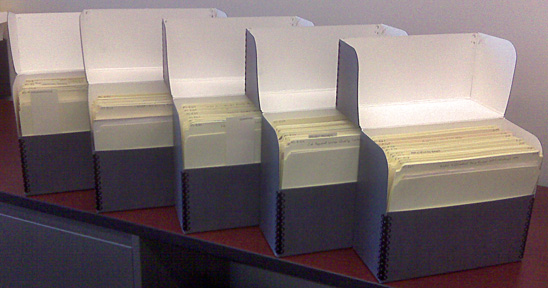 |
| ECOC boxes retrieved for moderate level processing. |
It took me all day to process at the moderate level, but in the end these additional efforts will have the effect of increasing the richness of the finding aid providing more detailed and varied keywords a researcher can analyze in their search results. And your humble Archivist Apprentice will have added another brick in the foundation of his experience.
Subscribe to:
Posts (Atom)